Back to Obisec Services
Encoding, Encryption and Hashing — the building blocks of data security
Free Interactive Lesson
An Obisec field lesson

Encoding / Encryption / HashingThe three words every thriller gets wrong

Three things that look alike and do completely different jobs. One you can undo for free, one you can undo only with a key, and one you can never undo at all. Type a sentence below and watch all three happen at once.
by Dimitrios Zacharopoulos
Free Interactive ~7 min Plain language No signup to learn

The one-line difference

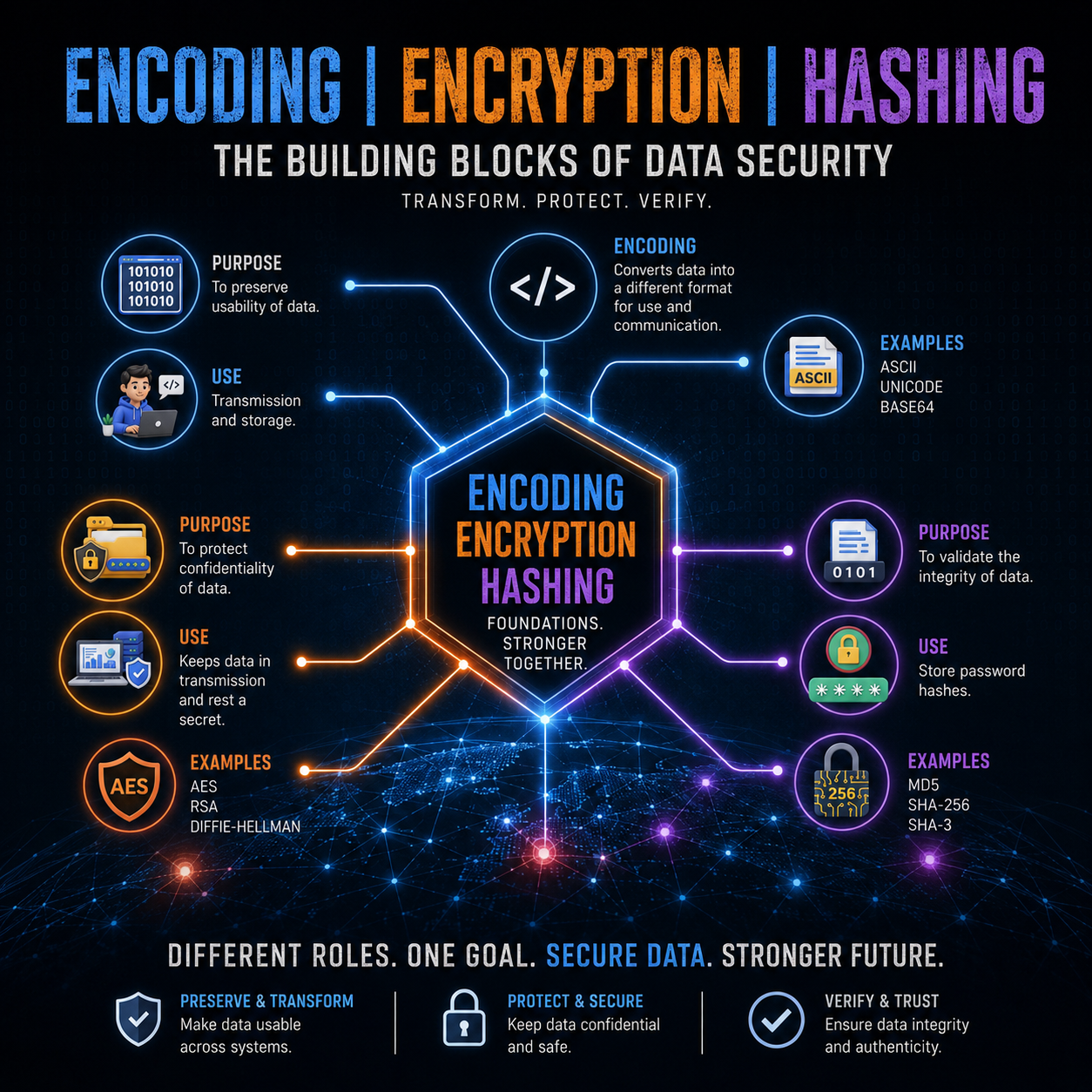
Encoding
Transform for compatibility
WhatReversibly rewrites data into another format so machines can handle it.
WhyTo preserve usability, not secrecy. Anyone can read it back.
ExamplesASCII, Unicode, Base64, URL encoding.
↺ Reversible by anyone · no key
Encryption
Protect confidentiality
WhatScrambles data with a key so only key-holders can read it.
WhyTo keep secrets in transit and at rest.
ExamplesAES, RSA, Diffie-Hellman.
↺ Reversible only with the key
Hashing
Verify integrity
WhatTurns any input into a fixed fingerprint that cannot be turned back.
WhyTo prove data has not changed, and to store passwords safely.
ExamplesSHA-256, SHA-3, (older: MD5).
✕ One-way · cannot be undone

The Transform Lab

One input, three fates. Type anything and watch it get encoded, encrypted, and hashed live. This is the whole lesson in one box.

ENCODING · Base64no key needed
ENCRYPTION · keyed cipherneeds the key
HASHING · SHA-256one-way
Watch what happens: the Base64 decodes straight back with no secret at all. The cipher only returns your sentence when the key matches, change one letter of the key and it turns to noise. The hash never comes back, and it is a completely different fingerprint even if you change a single character of the input.
!

What thrillers get wrong

The fun part. These lines show up on screen and on the page constantly. Tap each one to see why it makes a security person wince.

Just decrypt the hash and we'll have the password
A hash is one-way. There is nothing to decrypt, the original was thrown away the moment it was hashed. Attackers do not reverse hashes; they guess inputs, hash each guess, and look for a match. That is why long, unusual passwords matter: they make the guessing hopeless.
It's encrypted in Base64, we'll never crack it
Base64 is encoding, not encryption. There is no key and no secret. Anyone can decode it in one step, your browser can do it right now. It hides nothing; it only makes binary safe to paste into text.
I'll brute-force the encryption in a few seconds
Strong modern encryption like AES-256 has so many possible keys that trying them all would outlast the universe with today's hardware. Real attacks almost never break the maths; they steal the key, trick a person, or exploit a bug in how the encryption was used.
Two files with the same hash? Must be the same file
Usually true, and that is the point of a hash, but not a law. When two different inputs produce the same hash it is called a collision. Good modern hashes make this so rare it is effectively impossible; broken old ones like MD5 do not, which is exactly why they were retired.

Side by side

EncodingEncryptionHashing
GoalCompatibilityConfidentialityIntegrity
Needs a key?NoYesNo
Reversible?Yes, by anyoneYes, with the keyNo, ever
Output sizeVariesVariesAlways fixed
Keeps secrets?NoYesNo (it verifies)
Typical useTransmit & storeProtect messagesPasswords & checks
Remember it like this
Encoding is a costume. It changes how data looks so anyone can use it, and anyone can take the costume off.
🔒
Encryption is a locked box. The contents are safe until someone uses the right key to open it.
#
Hashing is a fingerprint. It proves what something is, but you can never rebuild the person from the print.
One last thought

Here is why this small distinction matters more than it looks.

Most stories about secrets fall apart the moment someone who knows the field reads them, because the writer never learned which things can be undone and which cannot. A plot that hinges on decrypting a hash is a plot built on a misunderstanding. Get the foundations right and something better happens: the tension becomes real, because the limits are real.

I spent the last 40 years working with this technology. The OBISEC trilogy is what came out by June 2026, a story where the encoding, the encryption and the one-way doors all behave the way they actually do, and where that accuracy is exactly what makes it frightening. It begins with CODENAME: LIB3RTY.

If you want to feel how this works with your own hands, you can also grab my free Domain Trust MCP and let your own AI assistant put these ideas to work.

A note on tone
This lesson explains what these techniques are for, the way a good thriller explains how a system works without becoming a manual. The cipher in the lab is a simple teaching demo, not real cryptography; for anything real, use vetted tools like AES. The goal is understanding, not capability. Written, designed and built for Obisec.
Obisec obisec.com  ·  A brand/service of Obipixel Ltd